Contribute
We are always open to updating and extending the guidelines and are waiting for your input!
All sources of this webpage are hosted on GitHub at ros-rvft.github.io. Contributions can be submitted directly to our GitHub repository. Here’s how to do it!
Step 1: Fork
Fork the project on GitHub and clone your fork locally. Make sure you do so from the ‘main’ branch.
git clone https://github.com/ros-rvft/ros-rvft.github.io
Step 2: Branch
Create a branch and start writing! You can modify existing guidelines, or propose a new one starting from our guideline template.
git checkout -b my-branch -t origin/main
Step 3: Commit
Submit all of your changed files and commit!
git add my/changed/files
git commit
Step 4: Push
Push your commits to the repository, creating a pull request to the main branch.
git push origin my-branch
Step 5: Discuss
After the pull request was created, keep track of it on GitHub where you can discuss your contributions with the team!
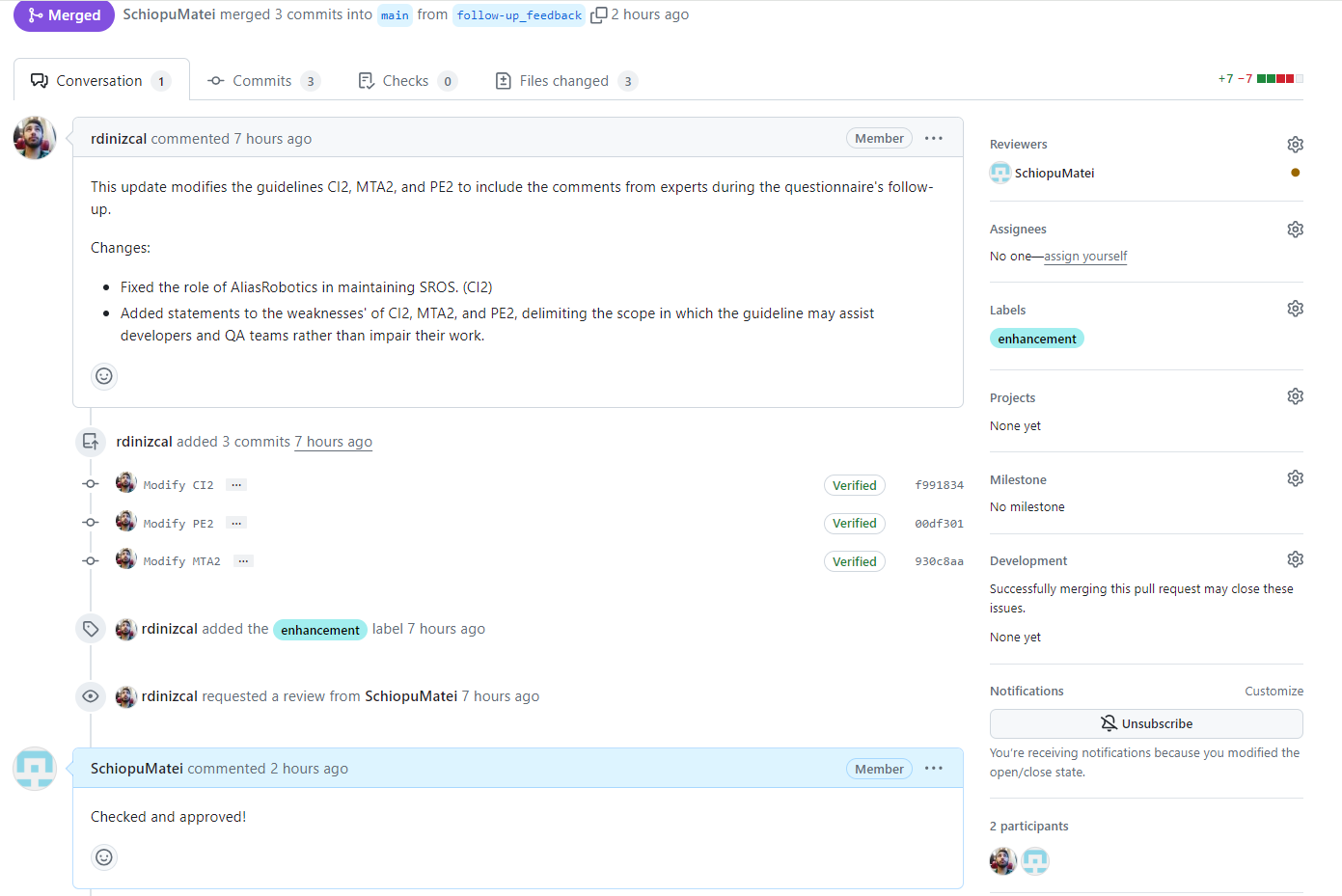
Step 6: Merge
The pull request review is finished and the final version of your contribution is added to the guidelines!
Here’s an example of a contribution: Feedback Pull Request
Feel free to fork and make additions directly to the source files. Create a pull request and we’ll begin discourse in the reviewing process!
You can also forward suggestions directly to ricardo.caldas@gssi.it!
What Makes a Good Contribution?
We welcome several kinds of contributions:
- New tools or techniques: Know a runtime verification tool, testing framework, or specification language for ROS that we haven’t covered? Suggest it! You can open a GitHub Issue describing the tool and which guideline it relates to — no need to write HTML.
- Updates to existing guidelines: Tools evolve. If a tool we reference has a new version, new features, or has been superseded, let us know.
- New worked examples: Practical examples showing how to apply a guideline with a specific tool are especially valuable.
- Corrections and improvements: Typos, broken links, unclear wording — all welcome.
Lightweight contribution (no Git required)
If you don’t want to fork and PR, you can simply open a GitHub Issue and pick from one of our templates:
- Suggest a Tool or Technique — for new tools we should cover.
- Update an Existing Guideline — for corrections, new versions, broken links.
- Report a Gap — for topics or practices the guidelines should address.
No Git, no HTML, no forking required.